

In This Article

Crosswinds in March
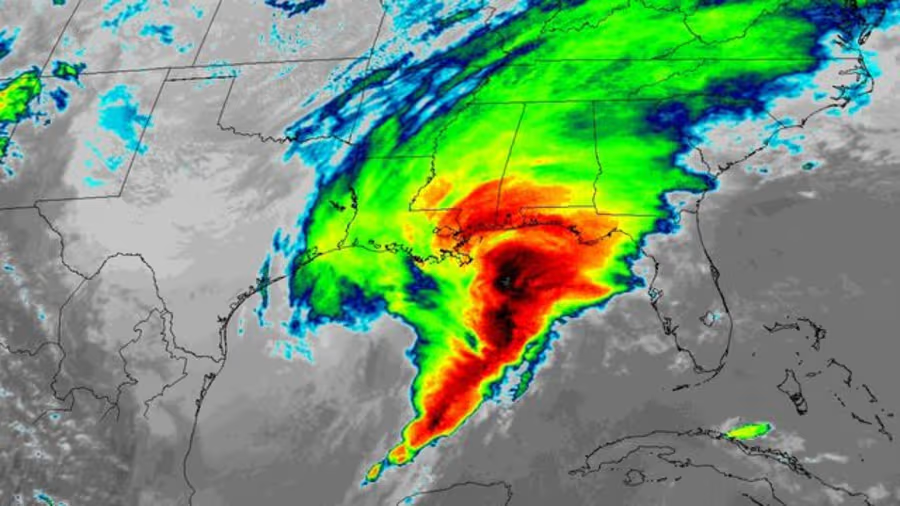
March 12–15, 1993 … The “Storm of the Century” … also known as the Great Blizzard of ’93!
A group of close friends and I were driving down I-95 from the University of Connecticut to Daytona Beach, Florida for Spring Break. In hindsight, it wasn’t the smartest decision we’d ever made?!
At the time, it didn’t feel questionable … It felt tense.
The snow was coming down hard enough to erase the horizon. The only visible path forward were the well-packed strips of snow carved out by the 18-wheelers ahead of us. We stayed in their tire tracks for significant lengths of the journey … blazing our own path wasn’t a very intelligent or viable option.
But the snow wasn’t the real problem … it was the crosswinds … they were strong enough to shove the van clear into adjacent lanes.
For those of you who don’t remember, this winter storm wasn’t a typical hurricane, it began as an extremely powerful extratropical cyclone, ultimately evolving into this massive “superstorm.”
Hurricane-force winds, Florida saw Tornadoes, coastal storm surges, blizzard conditions from Alabama to Maine with record snowfall in many Southeastern states.
It was brutal.
As we took turns driving, most of us gripped the steering wheel about as tightly as we ever have in our lifetimes … correcting, adjusting, correcting again. It felt like we were holding on for dear life.
Florida was the initial destination, that didn’t change.
But the crosswinds did.
Looking back, what mattered wasn’t predicting how long the storm would last. It was staying disciplined while it did.
That’s a useful metaphor for where markets sit today.
Quarterly Backdrop: Still Constructive
Let’s start with the hard data.
Growth remains solid.
- ISM Manufacturing rebounded +4.7 points in January to 52.6, the first expansion in 11 months and the highest reading in 41 months.
- New Orders surged +9.7 points to 57.1, a 47-month high.
- Backlogs rose to 51.6.
- Exports crossed back above 50.
- ISM Services held at 53.8, with Business Activity jumping to 57.4, the highest in 15 months.
On the growth side, Q4 2025 GDP is tracking roughly 2.7% SAAR, and Q1 2026 growth estimates have moved north of 3% YoY.
That is not recessionary data.
On inflation:
- January CPI nowcast sits near 2.50% YoY, down from December’s 2.68%.
- February CPI is tracking around 2.49% YoY.
- 1-year inflation expectations (University of Michigan) declined to 3.5%, the lowest in a year.
- 10-year breakevens hover near 2.30%.
At the quarterly level, this still resembles a Hedgeye Quad 1: growth accelerating, inflation broadly cooling … again, the destination hasn’t changed.
But the monthly crosswinds may be picking up?!
Monthly Tension: Inflation May Gust Higher
While headline CPI has decelerated, several forward inputs suggest March could see a modest re-acceleration:
- ISM Services Prices Paid rose to 66.6, a 3-month high.
- Core PPI finished December at +3.3% YoY.
- Import prices have stabilized.
- Oil prices briefly inflected higher in late January before pulling back.
- CPI base effects steepen in March.
If CPI accelerates in March with growth decelerating, even slightly from a RoC perspective, whether it remains positive or not … that would classify as a Hedgeye Monthly Quad 3.
Markets, being forward-discounting mechanisms, appear to be leaning into that probability.
The key question is not whether a Monthly Quad 3 appears.
It’s how long it lasts. Is it a brief gust dropping in for a “cup of coffee”? Or does it persist long enough to meaningfully shift positioning?
We don’t take chances in guessing … we’ll follow the signal.
Under the Surface: Labor & Flow Risk
The labor market tells a more nuanced story.
January payrolls increased +130,000, with private payrolls at +172,000. But 124,000 of those gains came from healthcare and social assistance.
Strip that out, and the broader labor picture looks far less robust.
Consider:
- JOLTS job openings fell to 6.5 million, the lowest since September 2020.
- Challenger layoffs totaled 108,435 in January … the highest January reading since 2009.
- Hiring plans collapsed to 5,306, the lowest January level on record (since 2009).
- The BLS benchmark revision erased -898,000 jobs from 2025 payroll data.
- Federal employment is down -327,000 from its October 2024 peak.
- January payroll tax withholdings grew just +1.0% YoY, marking a second consecutive slowdown.
- January FUTA tax receipts plunged -73.4% YoY … an extremely unusual development.
This is not a collapsing labor market … but it is not a tightening one either … and flows typically follow employment.
Passive flows, retirement contributions, and consumer spending all ultimately trace back to payroll growth. A softening hiring backdrop doesn’t guarantee market weakness, but it does increase sensitivity.
Structural Considerations
Markets also face structural crosscurrents.
In 2025, companies spent roughly $1 trillion on share buybacks, including an estimated $300 billion in Q4 alone.
In 2026, projected AI capital expenditures approach $650 billion … if buybacks slow while hiring remains muted, the marginal flow picture shifts.
At the same time:
- Mortgage applications have fallen three consecutive weeks.
- Existing home sales declined -8.4% MoM in January.
- Small business uncertainty (NFIB) jumped +7 points.
- China container shipments to the U.S. are down roughly -13% YoY.
- Rail traffic has flattened.
- Global M3 is accelerating, even as global growth shows mixed signals.
This is not a single narrative … it’s a complex mosaic.
Volatility Inside Strength
Here’s the important distinction:
Markets can become volatile even when the economy appears solid … volatility is not a synonym for recession.
It is often a function of positioning, liquidity, leverage, and shifting rate-of-change signals.
As we’ve discussed in the past, selling spirals most often fully express themselves in Quad 4 environments … defined by Hedgeye Risk Management as a period when both growth and inflation are simultaneously decelerating.
But volatility has the potential to spike at any time, especially during transitions between monthly investing regimes.
Hedgeye Founder & CEO, Keith McCollough often uses the phrase episodic and non-trending … most frequently to describe an irregular, often short-lived volatility spike.
But here’s the thing … “episodic and non-trending” is typically posed as a question:
“Is this/will this (what we’re currently seeing) be episodic and non-trending?!”
IQ allows us to recognize these episodes exists … but it takes EQ (and a little humility) to respond appropriately when they do.
Right now, quarterly growth remains constructive … monthly inflation is wobbling … labor is softening beneath the surface.
Markets are currently reacting accordingly … the road is still pointed forward, we’re still firmly behind the 18-wheeler driving in their tracks, but the crosswinds and gusts are picking up and much stronger on certain days than on others.
Process Over Prediction
Back in March 1993, we didn’t know how long the storm would linger … we didn’t try to out-forecast it … we stayed in the tire tracks and adjusted our speed when another driver pulled up next to us!
The last thing we wanted was to literally be blown into a vehicle driving too close who was ignoring the signals.
We corrected for the wind and maintained control.
Today, that means:
- Monitoring whether inflation acceleration persists beyond March.
- Watching employment flows closely.
- Observing how markets trade over multiple data points, while not over-reacting to one print.
If the signal persists, we adjust … if it fades, we recalibrate.
Again, while the destination hasn’t changed, in choppier conditions, discipline matters more.
Ironically, a volatility index (VIX) north of 20 places markets in what Hedgeye calls the “Chop” bucket … as I type, we sit below 19 (18.60).
Final Thoughts
Storms test drivers … volatility tests investors.
The worst decisions in both scenarios usually come from overcorrection … jerking the wheel, slamming the brakes, reacting emotionally.
Our job isn’t to predict how long the crosswinds last … it’s to navigate through them with a steady hand, mechanically guided by rate-of-change data and signal … not headlines.
The destination may not have changed — but if the crosswinds strengthen, are you positioned to stay in your lane without overcorrecting?
If you’d like to review how your portfolio is positioned for a potentially choppier stretch … whether this proves to be a brief inflation gust or something more prolonged … we’re always happy to sit down and walk through it together.
That being said, for those nearing retirement or having already done so … we continue to stress the importance of having a well-designed income/legacy plan in place. Risk-managing “markets” is merely one part of a proper plan.
Additionally, retirement planning isn’t just about numbers … it’s about people!
We make sure both spouses’ voices are heard and that your family’s income, and legacy are protected … no matter what life throws at you!
Both spouses. Both voices. One disciplined plan.
As always … Good investing!!
Mitchel C. Krause
Managing Principal & CCO

4141 Banks Stone Dr.
Raleigh, NC. 27603
phone: 919-249-9650
toll free: 844-300-7344
mitchel.krause@othersideam.com
Please click here for all disclosures.